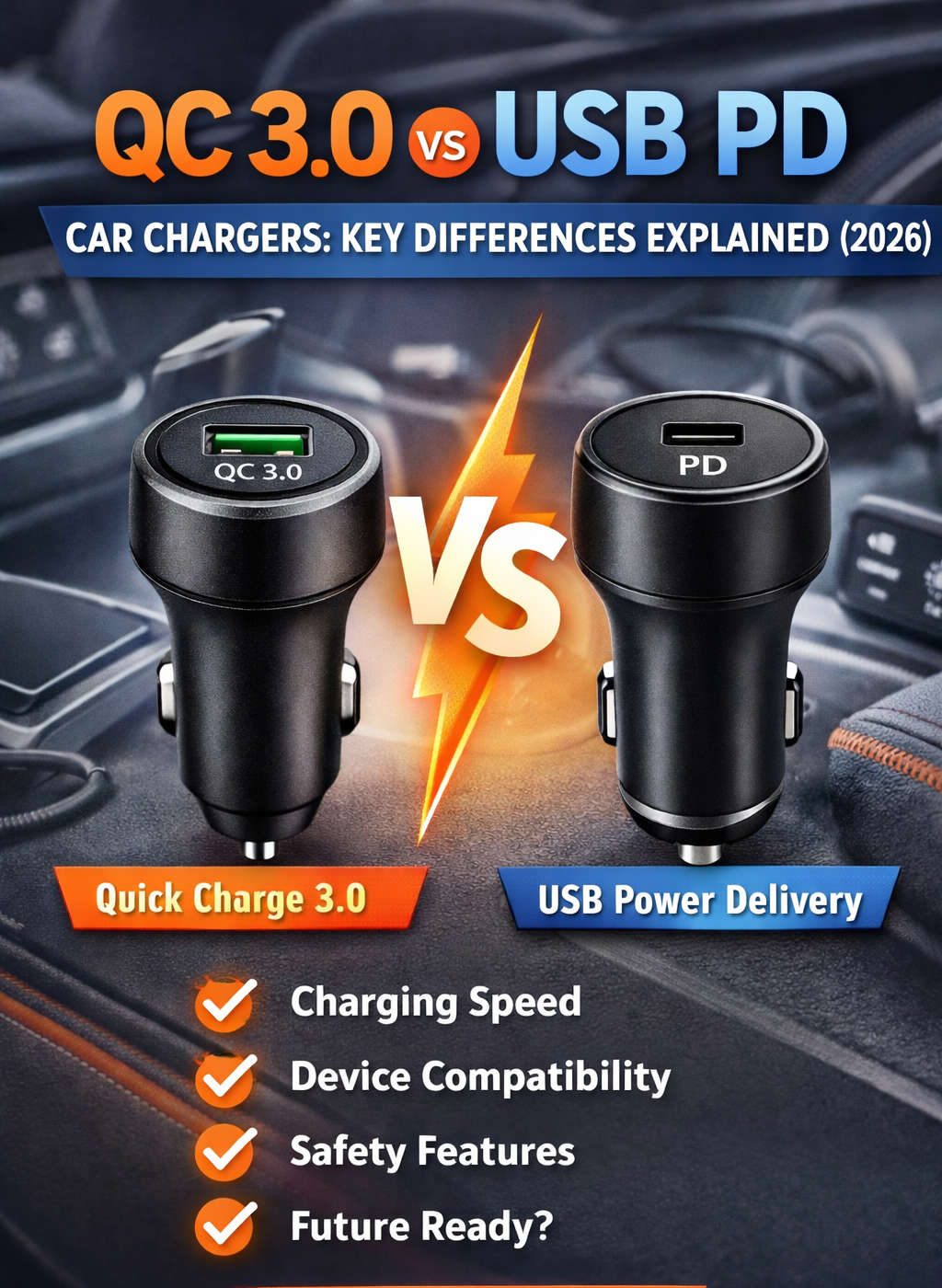
Fast charging is no longer a luxury—it is a necessity. In 2026, our cars have become mobile workspaces, navigation hubs, entertainment centers, and communication lifelines. Smartphones, tablets, dash cameras, and even laptops rely on car chargers to stay powered throughout the day. As device batteries grow larger and software becomes more power-intensive, the importance of choosing the right car charger has increased dramatically.
Two charging standards continue to dominate discussions in the automotive charging space: Qualcomm Quick Charge 3.0 (QC 3.0) and USB Power Delivery (USB PD). While both are designed to charge devices faster than traditional USB chargers, they differ significantly in how they work, what devices they support, and how future-proof they are.
This in-depth guide explains the real difference between QC 3.0 and PD car chargers in 2026, helping you make an informed decision based on your devices, driving habits, and long-term needs.
What Is Qualcomm Quick Charge 3.0?
Qualcomm Quick Charge 3.0 is a fast-charging technology developed primarily for smartphones powered by Qualcomm Snapdragon processors. It was a major step forward when introduced, significantly reducing charging times compared to standard USB charging.
How QC 3.0 Works
QC 3.0 uses a smart communication process between the charger and the device. Instead of delivering a fixed voltage, it dynamically adjusts voltage levels in small increments to match the device’s needs. This allows the charger to supply higher power without generating excessive heat.
In a car charging environment, QC 3.0 typically operates through USB-A ports and can deliver noticeably faster charging speeds for compatible devices, especially older Android smartphones.
Key Features of QC 3.0
- Variable voltage adjustment for improved efficiency
- Faster charging compared to standard 5V USB chargers
- Designed mainly for smartphones, not high-power devices
- Widely available and affordable in car chargers
Why QC 3.0 Was Popular
For several years, QC 3.0 was the go-to fast-charging standard for Android users. It offered a good balance of speed, safety, and cost. Many car chargers still include QC 3.0 ports because millions of devices in circulation support it.
However, technology has moved forward, and QC 3.0 now sits in a transitional position between older USB standards and newer universal solutions.
What Is USB Power Delivery (USB PD)?
USB Power Delivery is an open, industry-wide charging standard designed to work across a broad range of devices. Unlike proprietary systems, USB PD is governed by the USB Implementers Forum and is supported by nearly all major technology brands.
How USB PD Works
USB PD relies on a negotiation process between the charger and the connected device. When you plug in a device, both sides communicate to determine the optimal voltage and current. This allows the charger to deliver exactly the amount of power the device can safely accept.
USB PD supports multiple voltage levels and much higher power output than QC 3.0, making it suitable not only for smartphones but also for tablets, laptops, gaming devices, and accessories.
Evolution of USB PD
Over time, USB PD has evolved to support increasingly higher power levels. Modern PD chargers can deliver enough power to run and charge laptops directly from a car’s 12V or 24V system. Advanced versions also include Programmable Power Supply (PPS), which allows even finer control of voltage and current for improved efficiency.
Key Features of USB PD
- Universal compatibility across brands and device types
- High power output suitable for phones, tablets, and laptops
- Advanced power negotiation and safety mechanisms
- Designed around USB-C connectors for modern devices
USB PD is widely considered the most future-proof charging standard available today.
QC 3.0 vs USB PD: Core Differences Explained
Compatibility Across Devices
One of the most important differences between QC 3.0 and USB PD is device compatibility.
QC 3.0 works best with devices that were explicitly designed to support Qualcomm’s fast-charging protocol. These are typically older Android smartphones using Snapdragon processors. While QC 3.0 chargers can still power other devices, they do so at standard speeds rather than fast-charging rates.
USB PD, on the other hand, is designed to work with almost all modern devices. From Android phones and iPhones to tablets, wireless earbuds, power banks, and laptops, PD offers broad compatibility. In mixed-device households or shared vehicles, PD chargers provide a clear advantage.
Power Output and Charging Speed
QC 3.0 car chargers typically deliver moderate power levels that are ideal for smartphones. While they can charge phones quickly, they are not designed for high-power applications.
USB PD supports much higher power output. In 2026, PD car chargers commonly offer enough wattage to charge laptops, power portable monitors, or run multiple devices simultaneously. Even smartphones benefit from PD’s higher power ceiling, charging faster and more efficiently.
Charging Efficiency and Heat Management
Heat is one of the biggest enemies of battery health. QC 3.0 improves efficiency compared to basic chargers by adjusting voltage dynamically, but it still relies on older charging concepts.
USB PD, especially with PPS support, allows extremely precise control over voltage and current. This reduces wasted energy, lowers heat buildup, and improves long-term battery health. For users who charge their devices daily in the car, this efficiency difference becomes meaningful over time.
Connector Types and Cable Considerations
QC 3.0 and USB-A Ports
Most QC 3.0 car chargers use USB-A ports. While USB-A is familiar and widely compatible, it has limitations in terms of power delivery and future scalability. USB-A cables also vary significantly in quality, which can affect charging speed.
USB PD and USB-C Ports
USB PD is built around USB-C, which is now the standard connector for modern electronics. USB-C supports higher power, faster data transfer, and reversible plug orientation.
In 2026, USB-C is the preferred connector for long-term compatibility. Devices are increasingly shipped with USB-C cables, and manufacturers are phasing out older USB-A designs.
Safety and Reliability in Car Charging
Both QC 3.0 and USB PD include built-in safety mechanisms, but USB PD offers more advanced protection due to its standardized communication process.
Safety Features in QC 3.0
- Basic overvoltage protection
- Temperature monitoring
- Short-circuit prevention
These features are sufficient for smartphone charging but are limited when it comes to higher power applications.
Safety Features in USB PD
- Advanced power negotiation
- Real-time monitoring of voltage and current
- Improved thermal management
- Better support for multi-device charging
For drivers who charge multiple devices or expensive electronics, USB PD provides an added layer of reassurance.
Real-World Performance in 2026
Daily Commuters
For users who primarily charge a single smartphone during short commutes, both QC 3.0 and PD chargers can perform adequately. However, PD chargers typically deliver faster and more consistent results with newer phones.
Families and Shared Vehicles
In cars used by multiple people with different devices, USB PD is clearly superior. It eliminates compatibility issues and ensures that everyone gets fast charging regardless of device brand.
Professionals and Long-Distance Travelers
For business travelers, rideshare drivers, and digital nomads, USB PD is the only practical choice. The ability to charge laptops, tablets, and multiple phones simultaneously makes PD chargers indispensable.
Future-Proofing Your Car Charger Purchase
Technology changes quickly, and car chargers are no exception. QC 3.0, while still useful today, is approaching the end of its lifecycle. Newer devices increasingly rely on PD and PPS rather than proprietary standards.
USB PD continues to evolve, with higher power limits and broader adoption across industries. Choosing a PD-based car charger ensures compatibility with future devices and reduces the need for replacements.
Common Myths About QC 3.0 and USB PD
“QC 3.0 Is Just as Good as PD”
While QC 3.0 was excellent in its time, it cannot match PD’s power range, efficiency, or device support in 2026.
“USB PD Is Only for Laptops”
USB PD benefits smartphones just as much as laptops. Faster charging, better heat management, and universal compatibility make PD ideal for small devices as well.
“Higher Wattage Always Means Faster Charging”
Charging speed depends on what the device can accept, not just what the charger can deliver. PD’s advantage lies in its ability to match device requirements precisely.
How to Choose the Right Car Charger in 2026
When shopping for a car charger, consider the following factors:
Device Types
- Smartphones only: PD preferred, QC 3.0 acceptable for older devices
- Tablets and laptops: USB PD required
- Mixed devices: PD with multiple ports is ideal
Power Output
- Look for at least 30W PD for phones
- 60W or higher for tablets and laptops
- Multi-port chargers should balance power intelligently
Port Selection
- USB-C ports offer the best future compatibility
- USB-A ports are useful for legacy devices
Build Quality and Brand Reputation
A well-built charger with proper certifications ensures stable performance and long-term reliability.
Quick Comparison Summary
| Feature | QC 3.0 Car Chargers | USB PD Car Chargers |
|---|---|---|
| Compatibility | Limited | Universal |
| Max Power | Moderate | High |
| Connector Type | Mostly USB-A | USB-C |
| Efficiency | Good | Excellent |
| Future-Ready | Low | High |
| Best Use | Older smartphones | All modern devices |
Final Verdict: Which Is Better in 2026?
In 2026, USB Power Delivery is the clear winner for most users. Its universal compatibility, higher power output, superior efficiency, and future-proof design make it the best choice for modern car charging needs.
Qualcomm Quick Charge 3.0 still has a place for older devices, but it is no longer the ideal long-term solution. If you are investing in a new car charger today, USB PD offers better value, better performance, and better longevity.
Choosing the right car charger may seem like a small decision, but it has a daily impact on convenience, productivity, and device health. Understanding the difference between QC 3.0 and USB PD ensures that your car stays as connected and efficient as the rest of your digital life.
Discover more from Auto Volt Tech
Subscribe to get the latest posts sent to your email.
 Auto Volt Tech