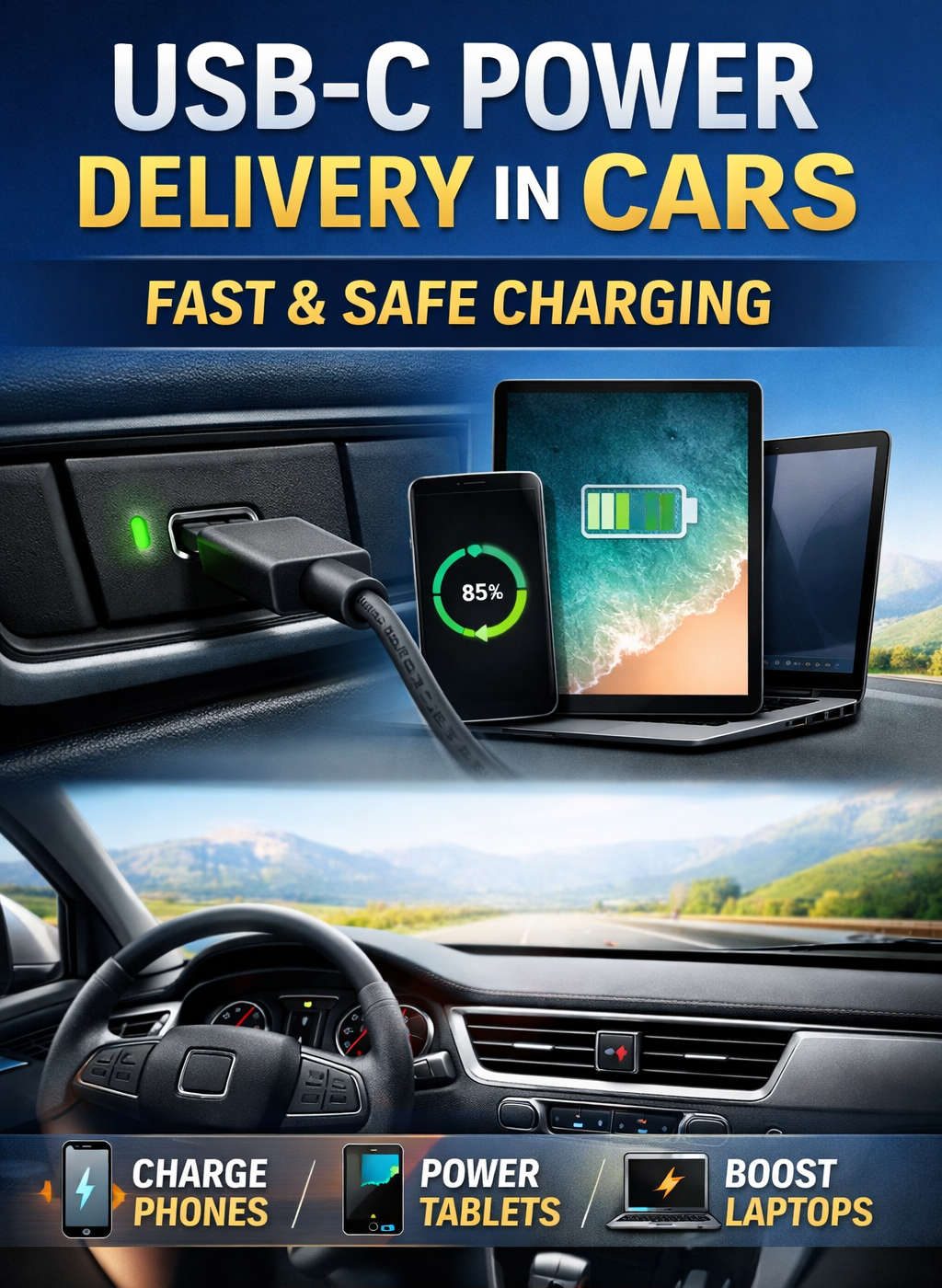
Modern cars are no longer just a means of transportation. They have become mobile workspaces, entertainment hubs, and digital ecosystems. From smartphones and tablets to laptops and gaming devices, drivers and passengers rely heavily on in-car charging. This growing demand for faster, safer, and more intelligent charging is exactly why USB-C Power Delivery has become a major focus in automotive design.
USB-C Power Delivery, often shortened to USB-C PD, is far more than just a new type of charging port. It is a smart power management system that allows vehicles to deliver the right amount of power to each connected device, efficiently and safely. To truly appreciate its impact, it helps to understand how it works, why it matters in cars specifically, and how it differs from older charging solutions.
The Evolution of In-Car Charging
For many years, in-car charging was limited and inconsistent. Early vehicles relied on the 12-volt accessory socket, originally designed for cigarette lighters. While adapters allowed phones to be charged, power output was low and unstable. As smartphones became more powerful, these solutions struggled to keep up.
The introduction of USB-A ports in cars was an improvement, but still had major limitations. Most USB-A ports delivered a fixed 5 volts and low current, resulting in slow charging—especially when navigation, music streaming, or hotspot features were active.
USB-C changed this landscape entirely. Combined with the Power Delivery protocol, it enabled cars to deliver significantly higher power levels while adapting dynamically to the needs of each device. This shift aligned perfectly with modern consumer expectations and the increasing electrical capabilities of vehicles.
What USB-C Power Delivery Really Means
USB-C refers to the physical connector—the small, reversible plug that works regardless of orientation. Power Delivery, on the other hand, is the intelligence behind the charging process.
USB-C Power Delivery is a communication-based system where the charger and the device actively talk to each other. Instead of blindly pushing power, the charger asks the device how much voltage and current it can safely accept. The device responds, and both sides agree on a power contract before energy flows.
This negotiation process allows USB-C PD to deliver power across a wide range of levels, from small accessories that need very little energy to laptops that require substantial wattage. The result is faster charging, reduced heat, and improved safety.
Why USB-C Power Delivery Is Ideal for Cars
Cars present a unique charging environment. Unlike wall outlets, vehicle electrical systems experience constant voltage fluctuations, temperature changes, and varying power demands. USB-C Power Delivery is well suited to handle these challenges.
One of the biggest advantages is adaptability. Whether the engine is starting, the alternator is under load, or the car is in accessory mode, a properly designed USB-C PD system can maintain stable and safe output.
Another key advantage is scalability. As consumer devices evolve and demand more power, USB-C PD ports in cars can support these needs without requiring entirely new charging infrastructure.
How Power Flows from the Car to Your Device
Understanding how USB-C Power Delivery works in cars starts with the vehicle’s electrical system.
Most cars operate on a nominal 12-volt system, powered by a battery and regulated by the alternator. Electric and hybrid vehicles may also include higher-voltage systems, but accessory electronics still rely on regulated lower voltages.
When a USB-C PD port is installed in a vehicle, it is connected to this electrical system through a DC-DC converter. This converter transforms the fluctuating vehicle voltage into stable output levels suitable for USB-C charging.
From there, a dedicated USB-C PD controller manages communication with connected devices. This controller is responsible for detecting the device, negotiating power levels, and monitoring safety conditions throughout the charging process.
The Role of Communication in USB-C PD
What makes USB-C Power Delivery truly intelligent is its communication mechanism. When you plug a device into a USB-C port in a car, several things happen almost instantly.
First, the port detects that a device has been connected. This happens through special configuration pins inside the USB-C connector. Once detected, the charger and device begin exchanging digital messages.
These messages determine:
- Whether the device supports Power Delivery
- What voltage and current levels the device can accept
- Whether higher power modes are safe to enable
Only after this negotiation is complete does the charger deliver power beyond the default low level. If the device does not support Power Delivery, the system safely falls back to standard charging.
This communication continues throughout the session. If the device’s needs change—such as when a laptop begins heavy processing—the power contract can be renegotiated dynamically.
Why Cars Need Smart Power Negotiation
In a home or office, power availability is rarely a concern. In a car, every watt matters. Multiple systems compete for energy, including climate control, infotainment, lighting, and safety features.
USB-C Power Delivery allows the vehicle to manage this competition intelligently. If the car detects low battery conditions or high system load, it can limit or disable high-power charging to preserve essential functions.
This intelligent allocation ensures that convenience features never compromise vehicle reliability.
Power Levels and Charging Speeds in Vehicles
One of the most noticeable benefits of USB-C Power Delivery in cars is faster charging.
Traditional USB ports often struggle to provide enough power to charge a phone while it is being actively used. USB-C PD can deliver significantly higher wattage, allowing devices to charge quickly even during heavy usage.
Depending on the vehicle and port design, USB-C PD in cars can support:
- Fast smartphone charging
- Tablet charging at full speed
- Laptop charging for productivity on the go
- Power for portable electronics and accessories
However, actual charging speed depends on multiple factors, including the vehicle’s electrical capacity, the PD controller design, and the capabilities of the connected device.
Heat Management and Efficiency
Delivering higher power always introduces the challenge of heat. In a confined automotive interior, thermal management is critical.
USB-C Power Delivery helps reduce heat by delivering power more efficiently. Higher voltage at lower current reduces energy loss in cables and connectors. Additionally, smart negotiation ensures that devices receive only the power they need, minimizing excess heat generation.
Automotive-grade USB-C PD systems are designed with thermal protection mechanisms. If temperatures exceed safe thresholds, the system can automatically reduce power output or shut down temporarily.
Safety Features Built into USB-C PD Systems
Safety is a top priority in automotive electronics, and USB-C Power Delivery includes multiple layers of protection.
These systems continuously monitor:
- Voltage levels
- Current flow
- Connector temperature
- Short circuits and overload conditions
If any abnormal condition is detected, power delivery is adjusted or stopped immediately. This protects both the vehicle and the connected device.
Additionally, automotive USB-C PD modules are built to withstand vibration, moisture, and extreme temperatures—conditions that consumer chargers are not designed for.
USB-C PD Compared to Older Charging Standards
The difference between USB-C Power Delivery and older charging methods becomes obvious in daily use.
Older USB ports deliver fixed power regardless of device needs. This results in slow charging, inefficient energy use, and frustration for users.
USB-C PD adapts in real time. It provides fast charging when possible, conserves energy when needed, and ensures compatibility across a wide range of devices.
For modern vehicles, the choice is clear: USB-C PD offers a superior user experience and future-proof design.
Integration with Infotainment and Vehicle Systems
USB-C PD ports in cars often do more than just charge devices. They may also support data transfer for infotainment systems, smartphone integration, and media playback.
Smart power management ensures that data performance is not compromised by charging demands. In some designs, the system prioritizes stable data connections while maintaining efficient power delivery.
As vehicles become more connected, this integration becomes increasingly important.
Challenges in Implementing USB-C PD in Cars
Despite its advantages, implementing USB-C Power Delivery in vehicles is not without challenges.
Automotive engineers must account for:
- Electrical noise and interference
- Voltage fluctuations during engine start
- Long-term durability requirements
- Compliance with strict safety standards
Designing a reliable USB-C PD system requires careful component selection, robust testing, and deep understanding of both automotive and USB standards.
Aftermarket USB-C PD Chargers for Cars
Not all vehicles come equipped with USB-C PD ports from the factory. Aftermarket solutions are widely available, but quality varies significantly.
When choosing an aftermarket USB-C PD car charger, it is important to look for:
- Genuine Power Delivery support
- Adequate power output for your devices
- Built-in safety protections
- Compatibility with your vehicle’s electrical system
Low-quality chargers may advertise high wattage but fail to deliver stable or safe performance.
USB-C Power Delivery in Electric Vehicles
Electric vehicles are particularly well suited for USB-C PD integration. With larger battery systems and advanced power management, EVs can support higher power accessory loads more easily.
In many EVs, USB-C PD ports are part of a broader digital ecosystem that includes wireless charging, multiple screens, and advanced connectivity features.
As EV adoption increases, USB-C PD is becoming a standard expectation rather than a premium feature.
The Future of USB-C Power Delivery in Cars
The future of in-car charging is closely tied to the evolution of USB-C Power Delivery.
Advancements in power electronics, such as more efficient semiconductor materials, will allow for smaller, cooler, and more powerful charging modules. Newer USB-C PD specifications support even higher power levels, opening the door to new use cases.
We can expect future vehicles to offer:
- More high-power USB-C ports
- Smarter power sharing between ports
- Seamless integration with wireless charging systems
- Personalized power management based on user profiles
As vehicles continue to evolve into connected digital platforms, USB-C Power Delivery will play a central role in supporting that transformation.
Practical Benefits for Everyday Drivers
From a user’s perspective, the benefits of USB-C Power Delivery in cars are clear.
Devices charge faster and more reliably. Cables work regardless of orientation. There is less need for bulky adapters. Passengers can confidently power laptops or tablets during long trips.
Most importantly, USB-C PD removes uncertainty. Users no longer have to wonder whether a port can handle their device—it adapts automatically.
Final Thoughts
USB-C Power Delivery represents a major step forward in automotive charging technology. By combining intelligent communication, flexible power delivery, and robust safety features, it addresses the limitations of older systems while preparing vehicles for future demands.
As more devices rely on USB-C and require higher power levels, cars equipped with USB-C PD are better positioned to meet modern expectations. Whether you are a driver, a passenger, or an automotive designer, understanding how USB-C Power Delivery works in cars provides valuable insight into the future of in-vehicle technology.
The shift to USB-C Power Delivery is not just about faster charging—it is about smarter energy management, improved safety, and a more seamless digital experience on the road.
Discover more from Auto Volt Tech
Subscribe to get the latest posts sent to your email.
 Auto Volt Tech