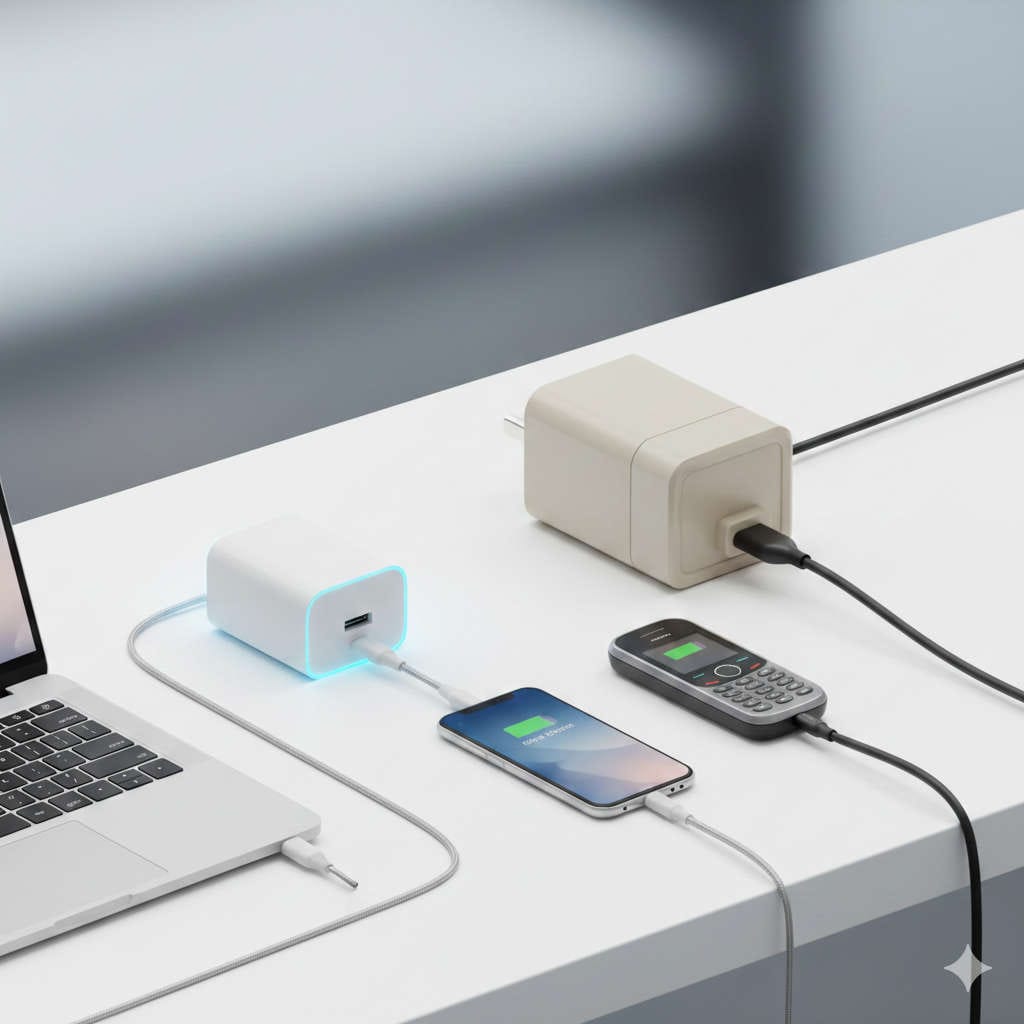
In today’s digital world, charging has quietly become one of the most important everyday technologies. Smartphones, laptops, tablets, wireless earbuds, power banks, gaming devices, and even household gadgets all depend on efficient, reliable power delivery. As these devices become more powerful, the demand for faster charging, smaller adapters, and better energy efficiency continues to grow.
This demand has led to a major shift in charging technology—one that is changing how chargers are designed and how power is delivered. That shift is GaN charging technology.
If you have noticed compact chargers that are surprisingly powerful, or adapters that stay cooler while charging multiple devices at once, you are already seeing GaN technology in action. This article explains what GaN charging technology is, how it works, why it matters, and how it benefits everyday users.
Understanding the Basics of GaN Charging Technology
GaN stands for Gallium Nitride, a semiconductor material that is increasingly replacing traditional silicon in power electronics. For decades, silicon was the industry standard because it was affordable, reliable, and well understood. However, silicon has physical limitations that become more noticeable as power demands increase.
Gallium Nitride belongs to a class of materials known as wide bandgap semiconductors. These materials can handle higher voltages, operate at higher frequencies, and manage power more efficiently than silicon. When applied to chargers, these properties allow for dramatic improvements in performance and size.
In simple terms, GaN charging technology enables chargers to deliver more power, more efficiently, and in much smaller designs.
Why Traditional Chargers Have Limitations
To understand why GaN is important, it helps to understand the weaknesses of conventional chargers.
Traditional silicon-based chargers rely on components that switch electricity on and off at relatively low frequencies. Because of this, they require larger transformers, larger capacitors, and additional cooling space. These components add bulk, weight, and heat.
As devices began supporting fast charging and higher wattage—especially laptops and tablets—silicon chargers struggled to keep up without becoming large, heavy, or excessively hot.
Key limitations of traditional silicon chargers include:
- Larger physical size
- Higher heat generation
- Lower efficiency at high power
- Reduced performance in multi-device charging
- Limited scalability for future power needs
GaN technology addresses these challenges at a fundamental level.
How GaN Charging Technology Works
At its core, every charger performs three essential tasks:
- Converts high-voltage AC power from the wall into low-voltage DC power
- Regulates voltage and current to match device requirements
- Manages heat and electrical safety
GaN transistors outperform silicon transistors in all three areas.
Because GaN transistors can switch power much faster, the charger operates at higher frequencies. Higher frequency operation allows designers to use smaller transformers and fewer supporting components, which significantly reduces size and weight.
Additionally, GaN transistors have lower electrical resistance, meaning less energy is wasted as heat. This results in:
- Improved efficiency
- Cooler operation
- Stable power delivery even at high wattages
The end result is a charger that feels almost futuristic—compact, powerful, and cool to the touch.
The Real Benefits of GaN Charging Technology
Smaller Chargers Without Compromising Power
One of the most noticeable advantages of GaN chargers is size reduction. A GaN charger delivering 65W or even 100W can be smaller than older 30W or 45W silicon chargers.
This size advantage is not just cosmetic. Smaller chargers are easier to carry, easier to pack, and more convenient for travel. Professionals, students, and digital nomads benefit greatly from a single compact charger that can power multiple devices.
Higher Efficiency and Energy Savings
Efficiency is a critical but often overlooked factor. When a charger is inefficient, a portion of the electricity drawn from the wall is lost as heat. GaN chargers significantly reduce this waste.
Higher efficiency means:
- Faster charging with stable output
- Reduced energy consumption
- Lower electricity costs over time
- Less strain on internal components
For users who charge multiple devices daily, the efficiency gains add up quickly.
Cooler Operation and Improved Safety
Heat is one of the main causes of charger failure and reduced lifespan. Excess heat can degrade components, affect charging performance, and pose safety risks.
GaN chargers generate less heat due to their efficient design. Even when delivering high power, they maintain safer operating temperatures. This makes them more reliable for long-term use and safer in environments where chargers are used continuously.
Faster Charging for Modern Devices
Fast charging standards require precise power regulation and high efficiency. GaN technology excels in this area, enabling support for advanced charging protocols.
Whether charging a smartphone at maximum speed or powering a laptop under heavy load, GaN chargers provide consistent, reliable output without voltage drops or overheating.
Multi-Device Charging Without Compromise
Many modern GaN chargers feature multiple ports, allowing users to charge several devices at once. Thanks to GaN’s efficiency, these chargers can intelligently distribute power without sacrificing speed or safety.
This is particularly useful for:
- Home offices
- Shared workspaces
- Travel scenarios
- Families with multiple devices
Instead of carrying multiple adapters, one GaN charger can handle everything.
GaN vs. Silicon Chargers: A Clear Comparison
While both GaN and silicon chargers perform the same basic function, the difference lies in performance and scalability.
Silicon chargers are mature, affordable, and reliable, but they struggle to meet modern power demands without growing in size.
GaN chargers, on the other hand, deliver:
- Higher power density
- Smaller designs
- Better thermal performance
- Greater efficiency
- Long-term scalability
As devices continue to demand more power, GaN offers a future-proof solution.
Common Applications of GaN Charging Technology
Smartphones and Wearables
GaN chargers are now widely used for smartphones, smartwatches, and wireless earbuds. Even compact GaN adapters can deliver fast charging while remaining portable and cool.
Laptops and Tablets
USB-C charging has transformed laptops, and GaN technology has accelerated this shift. Many laptops can now be charged using compact GaN chargers that replace bulky proprietary adapters.
This flexibility is especially valuable for professionals who rely on portable setups.
Home and Office Charging Stations
GaN chargers are ideal for desks and workstations. Multi-port models can power laptops, monitors, tablets, phones, and accessories from a single outlet, reducing cable clutter and improving efficiency.
Travel and Portable Power
For travelers, GaN chargers are game-changing. One small adapter can replace several chargers, saving space and reducing weight. Many GaN chargers also support international voltages, making them suitable for global travel.
Are GaN Chargers Safe?
Safety is a common concern with high-power chargers, especially compact ones. Reputable GaN chargers are designed with multiple safety mechanisms, including:
- Overvoltage protection
- Overcurrent protection
- Short-circuit protection
- Thermal monitoring
- Automatic power adjustment
When properly designed and certified, GaN chargers are just as safe—if not safer—than traditional chargers.
The key is choosing products from trusted manufacturers that meet international safety standards.
Misconceptions About GaN Charging Technology
“GaN Chargers Are Experimental”
GaN technology has been used in aerospace, telecommunications, and industrial systems for years. Its use in consumer chargers is a natural extension, not an experiment.
“Smaller Chargers Are Less Powerful”
With GaN technology, size no longer reflects capability. Compact GaN chargers often outperform larger silicon models.
“GaN Chargers Damage Batteries”
Charging speed is controlled by the device, not the charger. GaN chargers simply deliver power more efficiently. When used with compatible devices, they do not harm batteries.
How to Choose the Right GaN Charger
Understand Your Power Needs
Check the wattage requirements of your devices. Phones generally require less power than laptops, but high-performance laptops may need 65W, 90W, or more.
Choose a charger that meets or exceeds your highest requirement.
Decide on Port Configuration
Single-port chargers are ideal for minimalists, while multi-port chargers suit users with multiple devices. Ensure the charger can deliver full power even when multiple ports are in use.
Check Charging Standards
Support for modern charging standards ensures compatibility and fast charging performance. Look for chargers designed for today’s devices, not outdated protocols.
Focus on Build Quality and Certification
A well-built charger lasts longer, performs better, and offers peace of mind. Quality materials, proper insulation, and safety certifications matter more than flashy marketing.
Environmental Impact of GaN Technology
GaN chargers are not just better for users—they are better for the environment.
Higher efficiency means less wasted energy. Smaller chargers require fewer raw materials. Longer lifespan reduces electronic waste. Together, these factors make GaN technology a more sustainable choice.
As energy efficiency becomes a global priority, GaN chargers play a meaningful role in reducing overall power consumption.
The Future of GaN Charging Technology
GaN technology is still evolving. Future developments may include:
- Even higher power output in smaller designs
- Integration with smart energy management systems
- Wider adoption in wireless charging
- Use in electric vehicle charging infrastructure
As manufacturing improves and costs continue to fall, GaN is expected to become the new standard across the charging industry.
Final Thoughts: Is GaN Charging Technology Worth It?
GaN charging technology represents a genuine leap forward in how we power our devices. It is not just a minor upgrade—it is a fundamental improvement in efficiency, performance, and convenience.
For everyday users, GaN chargers offer:
- Faster charging
- Smaller, lighter designs
- Better thermal performance
- Safer and more reliable operation
- Future-ready compatibility
Whether you are upgrading a home office, simplifying your travel gear, or investing in long-term reliability, GaN chargers provide clear, practical benefits.
As devices continue to demand more power in smaller forms, GaN charging technology is not just an option—it is the direction the industry is moving toward.
Discover more from Auto Volt Tech
Subscribe to get the latest posts sent to your email.
 Auto Volt Tech