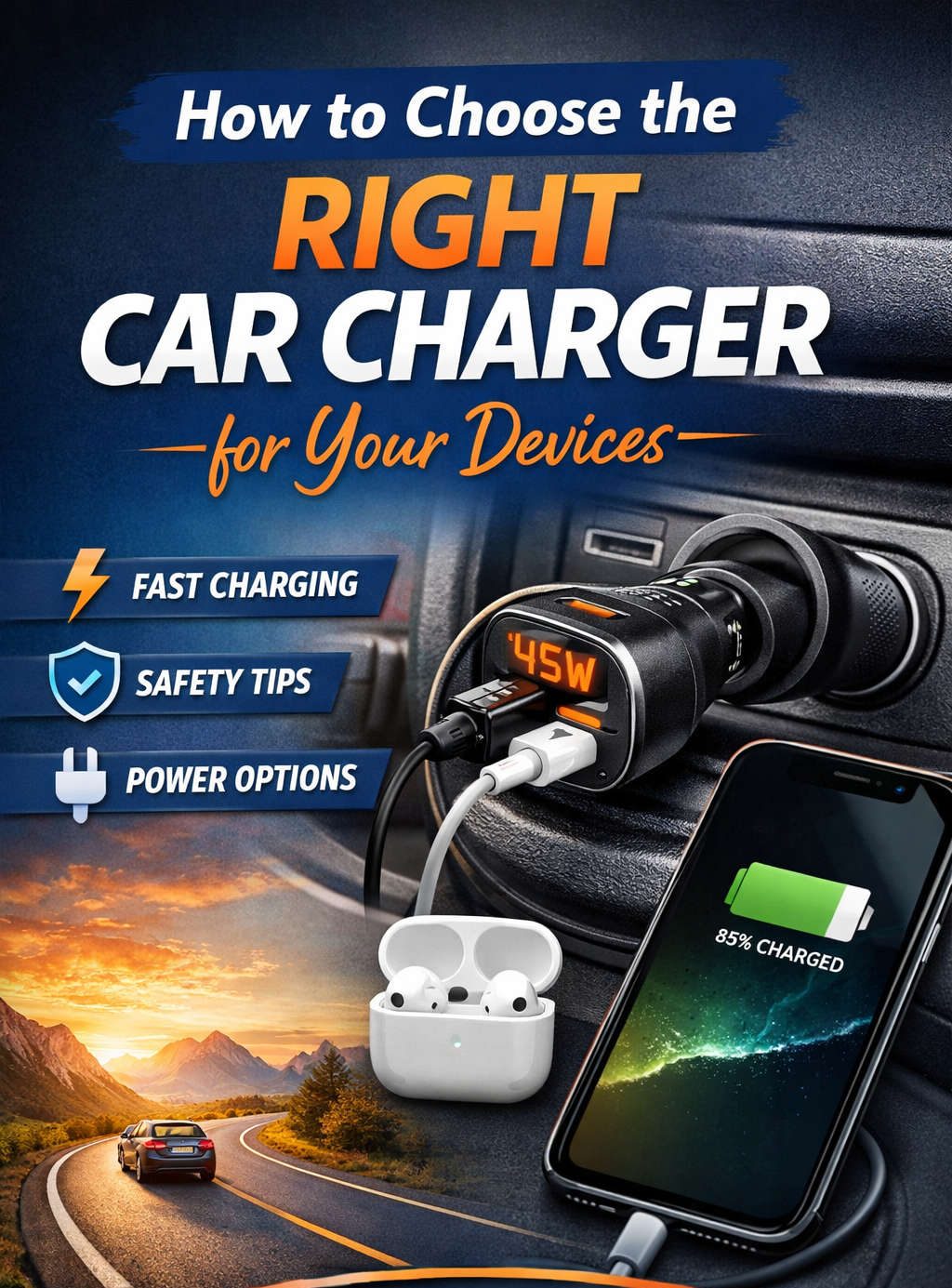
Modern life depends heavily on mobile devices. Smartphones guide us with navigation, keep us connected through calls and messages, stream music, manage work emails, and even control smart home features. When you are driving, especially for long hours, your phone’s battery can drain faster than expected. GPS, mobile data, Bluetooth, and screen brightness all work together to consume power quickly.
A car charger may look like a small and simple accessory, but choosing the wrong one can lead to slow charging, overheating, damaged cables, or even long-term battery health issues. On the other hand, choosing the right car charger ensures fast, stable, and safe power delivery to your devices whenever you are on the road.
This guide will help you understand how car chargers work, what features really matter, and how to select the best option for your specific devices and driving habits.
How Car Chargers Actually Work Inside Your Vehicle
A car charger plugs into your vehicle’s 12V power outlet, commonly known as the cigarette lighter socket. However, your phone or tablet cannot safely accept that level of voltage. The charger’s internal circuitry converts the vehicle’s higher voltage into a lower, controlled output suitable for charging mobile devices.
Good car chargers regulate power carefully, adjusting voltage and current based on what the connected device requests. Cheap or poorly designed chargers often fail to regulate this properly, which can result in inconsistent charging speeds or excess heat.
Understanding this conversion process helps explain why quality matters far more than price when it comes to car chargers.
Key Charging Terms You Should Know Before Buying
Before choosing a car charger, it is important to understand a few basic charging terms. These concepts will help you make an informed decision rather than guessing based on appearance or marketing claims.
Voltage Explained in Simple Terms
Voltage represents the electrical pressure delivered to your device. Most standard charging happens at around 5 volts, but fast charging technologies often increase voltage temporarily to deliver more power efficiently.
Higher voltage does not mean danger when handled correctly. Modern devices communicate with chargers to request the voltage they can safely accept.
Current and Charging Speed
Current, measured in amps, determines how much electricity flows into your device. Higher current usually results in faster charging, but only up to the limit your device supports. Supplying more current than needed does not speed things up and can create unnecessary heat.
Wattage and Why It Matters Most
Wattage is calculated by multiplying voltage and current. This number tells you how much total power the charger can deliver. A charger with higher wattage can charge devices faster or power larger devices like tablets and laptops, provided the device supports it.
For most smartphones, chargers in the 18W to 30W range are ideal. Tablets and laptops usually need significantly more power.
Different Types of Car Chargers Available Today
Car chargers come in many designs and configurations. Choosing the right type depends on how many devices you charge, what kind of devices you own, and how you use your car.
Single-Port Car Chargers
Single-port chargers are compact and straightforward. They are ideal for drivers who only need to charge one device at a time.
These chargers are small, affordable, and easy to store. However, they can feel limiting if you ever need to charge more than one device, such as a phone and wireless earbuds at the same time.
Multi-Port Car Chargers
Multi-port chargers are perfect for families, shared vehicles, or long trips. They allow multiple devices to charge simultaneously from one power outlet.
High-quality multi-port chargers distribute power intelligently, ensuring that each connected device receives the appropriate amount of power without slowing others down.
USB-A vs USB-C Chargers
USB-A ports are older but still widely compatible with many cables and devices. USB-C ports are newer and support faster charging and higher power delivery.
A charger with both USB-A and USB-C ports offers the most flexibility, especially if you own a mix of older and newer devices.
Wireless Car Chargers
Wireless car chargers combine a charging pad with a phone mount. They allow you to charge your phone simply by placing it on the pad.
While wireless charging is convenient and reduces cable clutter, it is usually slower than wired charging and more sensitive to phone placement. Heat buildup can also be higher during wireless charging.
Fast Charging Standards You Need to Understand
Fast charging is not a single technology. Different devices support different charging standards, and matching the charger to your device’s standard is essential for maximum speed.
USB Power Delivery
USB Power Delivery is a widely used standard that supports fast and efficient charging across many devices. It allows chargers and devices to communicate and adjust power levels dynamically.
This standard is commonly used by modern smartphones, tablets, and even laptops that charge via USB-C.
Quick Charge Technology
Quick Charge is commonly found in many Android devices. It increases charging speed by raising voltage when needed, reducing charging time significantly compared to standard charging.
A charger that supports Quick Charge can still charge non-Quick Charge devices, but it will fall back to normal speeds.
Device-Specific Fast Charging
Some manufacturers use customized charging methods that work best with compatible chargers. While these chargers are often backward compatible, optimal speeds are achieved when both the charger and device support the same fast-charging protocol.
How to Choose the Right Power Output for Your Devices
Choosing the right wattage is one of the most important decisions when buying a car charger.
Charging Smartphones Efficiently
Most modern smartphones charge best with chargers offering between 18W and 30W. Using a lower-power charger will still work, but charging times will be longer, especially when using navigation or streaming apps.
Powering Tablets and Larger Devices
Tablets typically require more power than phones. A charger delivering at least 30W ensures stable charging without draining the battery during use.
Charging Laptops in the Car
Some lightweight laptops can charge via USB-C. These devices often require 45W or more. Not all car chargers support laptop charging, so this feature should be clearly confirmed before purchase.
Safety Features You Should Never Ignore
Safety is often overlooked when buying a car charger, but it is one of the most important aspects.
Protection Against Overheating
Cars can get extremely hot, especially during summer. A good charger includes thermal management to prevent overheating and automatically reduce power output when temperatures rise.
Overcurrent and Overvoltage Protection
These features prevent excessive power from reaching your device. Without them, batteries can degrade faster or become permanently damaged.
Short-Circuit Protection
Short-circuit protection immediately cuts off power if a fault is detected, protecting both your devices and your vehicle’s electrical system.
Build Quality and Design Considerations
A charger’s design affects both usability and durability.
Compact vs Extended Designs
Compact chargers sit flush with the car’s power outlet, keeping the interior neat. Extended chargers may be easier to unplug but can interfere with nearby controls in some vehicles.
Material Quality
Heat-resistant materials and solid internal components improve longevity. Lightweight plastic chargers often wear out quickly or become loose over time.
LED Indicators
Subtle LED indicators help you confirm that the charger is powered and working, especially at night. Overly bright LEDs can be distracting while driving.
Choosing the Right Cable Is Just as Important
Even the best charger cannot perform well with a poor-quality cable.
Low-quality cables limit charging speed, generate heat, and wear out quickly. Always use cables rated for fast charging and high power output, especially with USB-C chargers.
Shorter cables are usually better for cars because they reduce clutter and power loss.
How Many Charging Ports Do You Really Need?
The number of ports you need depends on your daily routine.
For Solo Drivers
One or two ports are usually enough. A single high-power USB-C port can handle most modern devices efficiently.
For Families or Shared Vehicles
Multiple ports are essential. Look for chargers with at least three or four ports and intelligent power distribution so everyone can charge without slowdowns.
For Professional Drivers
If you rely on multiple devices for work, such as phones, tablets, or hotspots, a high-capacity multi-port charger is a smart investment.
Best Practices for Using a Car Charger Safely
Using your charger correctly can extend both the charger’s lifespan and your device’s battery health.
Avoid leaving devices charging in direct sunlight for long periods. Heat is the biggest enemy of lithium-ion batteries.
Unplug chargers when not in use to reduce unnecessary power draw and wear.
Avoid charging devices from extremely low battery levels repeatedly, as this can stress batteries over time.
Common Mistakes People Make When Buying Car Chargers
Many drivers make avoidable mistakes that lead to poor charging experiences.
Buying the cheapest option often results in slow speeds and safety risks.
Ignoring fast-charging compatibility means missing out on faster charging your device already supports.
Assuming all USB-C chargers are the same can lead to disappointment, as wattage and standards vary widely.
How to Future-Proof Your Car Charger Purchase
Technology evolves quickly, but you can still make a future-proof choice.
Choose chargers with USB-C ports and higher wattage than you currently need. This ensures compatibility with future devices.
Multi-port chargers with flexible power distribution adapt better as your device collection grows.
Real-World Scenarios to Help You Decide
If you mostly commute short distances, a simple fast charger may be enough.
For road trips, a multi-port charger ensures everyone stays powered.
If you work remotely from your car, investing in a high-wattage charger that supports tablets or laptops makes a big difference.
Final Thoughts on Choosing the Right Car Charger
Choosing the right car charger is not just about convenience. It is about protecting your devices, improving charging efficiency, and ensuring reliability every time you drive.
By understanding charging standards, power requirements, safety features, and real-world usage scenarios, you can confidently select a charger that meets your needs today and continues to perform well in the future.
A well-chosen car charger turns your vehicle into a reliable power hub, keeping you connected, productive, and stress-free wherever the road takes you.
Discover more from Auto Volt Tech
Subscribe to get the latest posts sent to your email.
 Auto Volt Tech