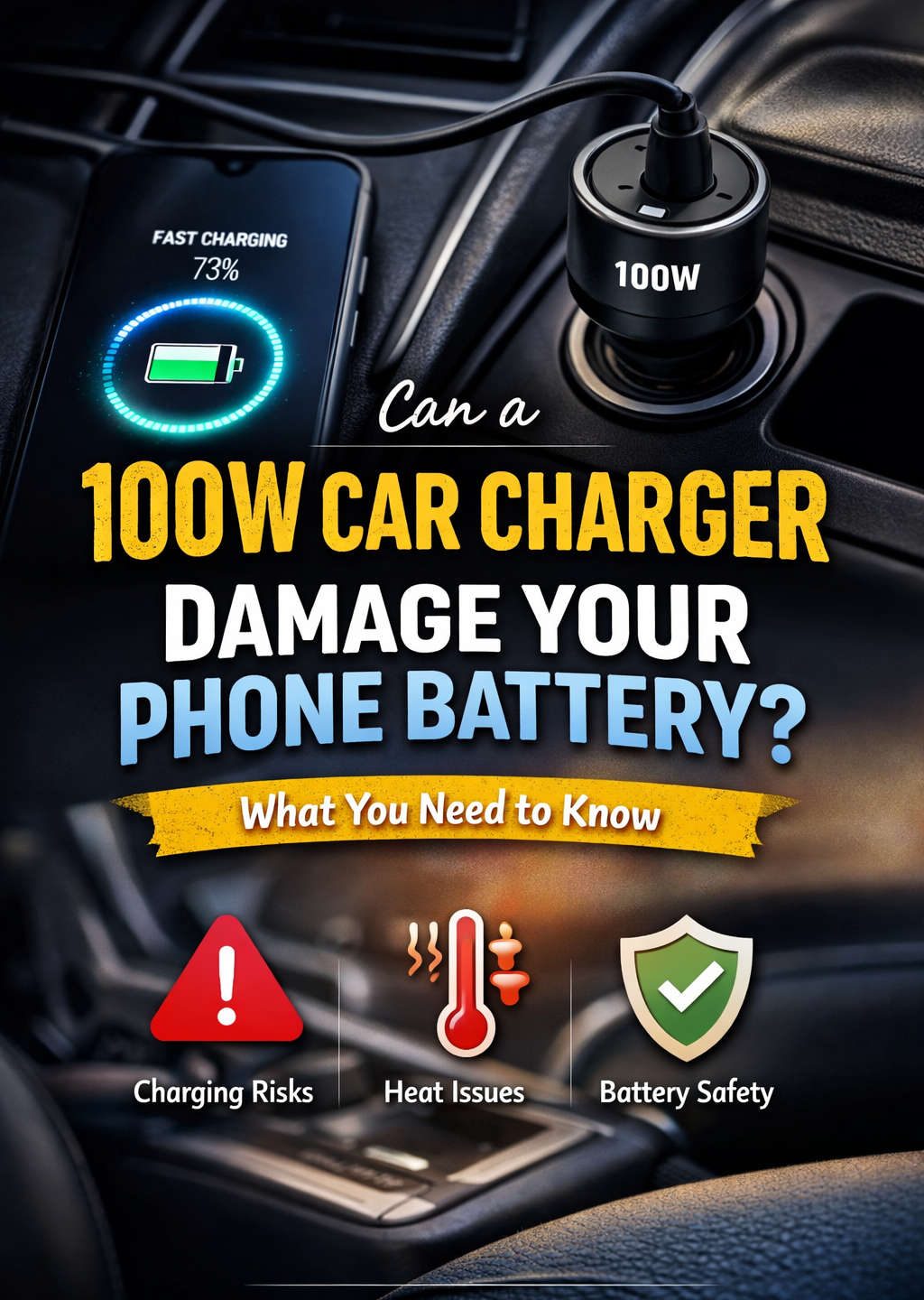
Fast charging has gone from being a luxury feature to an everyday expectation. Many people now charge their phones in the car while commuting, traveling, or navigating with GPS for hours at a time. As chargers become more powerful, one question keeps coming up again and again: can a 100W car charger damage my phone battery?
At first glance, the concern makes sense. A smartphone battery is small, delicate, and expensive to replace. A 100-watt charger sounds massive by comparison. It’s easy to imagine too much power being forced into the phone, overheating it, or slowly destroying the battery from the inside.
The reality, however, is far more nuanced — and much more reassuring — than many people think.
This article breaks down everything you need to know: how phone charging actually works, what “100W” really means, when it’s safe, when it’s risky, and how to protect your battery for the long run. By the end, you’ll understand not just whether a 100W car charger can cause damage, but why it usually doesn’t — and what truly matters instead.
Understanding What “100W” Actually Means
The biggest misunderstanding around high-wattage chargers is the assumption that wattage equals force. Many people think a 100W charger constantly pushes 100 watts into whatever is plugged in. That’s not how modern charging works.
A 100W charger is simply capable of delivering up to 100 watts. It does not automatically send that amount of power into every device.
Think of it like a water faucet connected to a large water tank. The tank may hold thousands of liters, but the faucet only releases as much water as you open it for. In charging, your phone controls the faucet.
Modern smartphones are designed to request only the amount of power they can safely handle. If your phone supports 18W, 25W, or 45W charging, it will never pull 100W — even if the charger can provide it.
This is made possible by intelligent communication between the charger and the phone.
How Phones Control Charging Power
Inside every modern smartphone is a battery management system. This system is responsible for regulating voltage, current, temperature, and charging speed. When you plug your phone into a charger, a digital conversation happens almost instantly.
The charger announces what power levels it can supply.
The phone checks what it supports.
They agree on a safe level.
Only then does charging begin.
If your phone does not support high-wattage charging, it simply ignores the extra capability. The charger becomes overqualified, not dangerous.
This is why a phone that supports 20W charging will still charge safely from a 100W charger — it just won’t charge any faster than its design allows.
Why Heat Matters More Than Wattage
When people talk about battery damage, what they’re really talking about — whether they realize it or not — is heat.
Lithium-ion batteries don’t hate power.
They hate excessive temperature.
Every time you charge a battery, chemical reactions occur inside it. The faster those reactions happen, the more heat is produced. Over time, repeated exposure to high heat accelerates battery aging.
That’s why fast charging has always raised concerns. More power can mean more heat — but only if it isn’t managed properly.
Modern phones constantly monitor their internal temperature. If heat rises beyond a safe threshold, the phone automatically slows charging or pauses it entirely. You might notice your phone charging rapidly from 10% to 50%, then slowing down significantly afterward. That’s not a flaw — it’s protection.
So the real question isn’t “is 100W too much?”
It’s “does this setup cause excessive heat?”
In most cases, the answer is no.
Can a 100W Car Charger Damage Your Phone Battery?
For the vast majority of users, a 100W car charger will not damage a phone battery.
Here’s why:
First, your phone decides how much power it takes, not the charger.
Second, modern charging standards include strict safety limits.
Third, phones are designed with thermal protection systems.
If everything involved — charger, cable, phone — meets proper standards, there is no mechanism for a charger to “overpower” the battery.
The charger does not shove energy into the phone. The phone pulls what it wants.
In other words, using a 100W charger is not inherently more dangerous than using a 30W charger. The difference is simply the charger’s maximum potential, not its constant output.
Why Some People Still Experience Battery Problems
Despite all this, some users do experience overheating, rapid battery wear, or charging issues. When that happens, the charger’s wattage often gets blamed — but the real causes usually lie elsewhere.
One of the most common issues is low-quality chargers. Cheap, unregulated chargers may claim high wattage but lack proper power negotiation or voltage stability. These chargers can cause inconsistent current flow, leading to heat spikes and long-term stress on the battery.
Another frequent problem is poor-quality cables. Not all cables are built to handle fast charging. A cable that cannot safely carry higher current may overheat, drop voltage, or cause inefficient charging — all of which generate heat inside the phone.
Environmental heat is another major factor. Charging in a parked car on a hot day can push internal temperatures well beyond safe limits. Even a perfectly good charger cannot protect a battery from ambient heat combined with fast charging.
Finally, phone usage during charging matters. Running GPS, streaming video, or gaming while fast charging creates extra heat from the processor. When combined with charging heat, this can accelerate battery wear.
In most of these cases, the problem isn’t the 100W rating — it’s how and where the charging happens.
The Special Case of Car Charging
Charging in a car introduces unique conditions that don’t exist at home or in the office.
Car interiors can heat up quickly, especially in direct sunlight. Dashboards and center consoles often trap heat. Phones mounted for navigation may sit inches from hot glass while charging at the same time.
This environment alone can raise battery temperature significantly — even with moderate charging speeds.
That doesn’t mean you shouldn’t charge in the car. It simply means you should be mindful. A 100W charger in a cool, ventilated cabin is far safer than a slow charger in extreme heat.
Temperature always outweighs wattage.
Does Fast Charging Reduce Battery Lifespan?
This is one of the most common questions, and the honest answer is: yes, but not nearly as much as people fear.
All lithium batteries degrade over time. Every charge cycle slightly reduces capacity. Fast charging can increase this wear marginally because it speeds up chemical reactions and produces more heat.
However, modern phones are designed with this reality in mind. Charging algorithms slow down at higher battery percentages, reduce power when temperatures rise, and optimize current flow to minimize stress.
For most users, the difference between always using fast charging and occasionally using slower charging amounts to months, not years, of battery lifespan.
In real-world terms, most people replace their phones long before fast charging causes serious battery issues.
When a 100W Charger Can Become a Problem
While generally safe, there are situations where using a high-wattage charger can increase risk.
Using uncertified or counterfeit chargers is the biggest one. These chargers may lack proper voltage regulation and safety cutoffs.
Another risk comes from damaged cables. Frayed or bent cables can cause resistance, leading to heat buildup.
Charging in extreme heat, as mentioned earlier, is also a major factor. Even the best charger can’t overcome physics.
Older phones that lack modern charging protocols may also behave less efficiently, though most still include basic protections.
Finally, constantly charging from very low to 100% at maximum speed can increase wear over time. Batteries prefer partial cycles rather than full extremes.
None of these risks are unique to 100W chargers — but higher-power setups make good practices more important.
How to Use a 100W Car Charger Safely
If you want to enjoy fast, convenient charging without worrying about battery damage, a few simple habits make a big difference.
Use chargers from reputable brands that follow modern charging standards. Avoid no-name products that advertise high wattage without clear certification.
Pair your charger with a cable rated for fast charging. A good cable is just as important as a good charger.
Avoid charging in extreme heat. If the car is very hot, let it cool down before plugging in your phone.
Remove phone cases if they trap heat, especially thick or insulated ones.
Avoid heavy phone usage while fast charging. Navigation is fine, but gaming or video streaming adds unnecessary heat.
If you don’t need fast charging, unplug once you reach a comfortable level instead of pushing to 100%.
These habits do far more for battery health than worrying about charger wattage alone.
Is There Any Benefit to a 100W Charger for Phones?
Even if your phone doesn’t support ultra-fast charging, a 100W charger still has advantages.
It’s future-proof. Newer phones are steadily increasing their charging capabilities.
It’s versatile. You can charge tablets, laptops, cameras, and other devices from one charger.
It often includes smarter power management because high-wattage chargers tend to use better components.
In many cases, a high-quality 100W charger is actually safer than a cheap low-wattage one.
Common Myths About High-Wattage Chargers
One common myth is that a charger “forces” power into the phone. In reality, the phone pulls power.
Another myth is that fast charging always overheats batteries. Heat depends on efficiency, not speed alone.
Some believe that slow charging is always better. While it can reduce heat slightly, modern fast charging is designed to stay within safe limits.
There’s also the idea that using powerful chargers will instantly damage batteries. Battery degradation is gradual, not sudden.
Understanding these myths helps reduce unnecessary fear and confusion.
What Phone Manufacturers Expect You to Do
Phone manufacturers design devices assuming users will use fast chargers. They test batteries under fast-charging conditions for years of simulated use.
Built-in protections exist because manufacturers know people will charge in cars, airports, cafés, and everywhere in between.
If using a certified charger damaged phones routinely, fast charging wouldn’t exist at all.
The Real Enemies of Battery Health
If you’re serious about preserving battery life, focus on these factors instead of wattage:
Excessive heat
Cheap charging accessories
Physical damage
Constant full discharges
Leaving phones in hot cars
These have a far greater impact than whether your charger is rated at 30W or 100W.
Final Verdict
A 100W car charger does not damage your phone battery by default.
Modern smartphones are intelligent, self-regulating devices. They control how much power they accept, monitor temperature constantly, and protect themselves from unsafe conditions.
When paired with a quality charger, a proper cable, and reasonable charging habits, a 100W car charger is not only safe — it’s convenient, efficient, and future-ready.
If battery health is your concern, focus less on the number printed on the charger and more on heat management, accessory quality, and everyday charging habits.
Used correctly, a 100W car charger is a tool — not a threat — to your phone’s battery.
Discover more from Auto Volt Tech
Subscribe to get the latest posts sent to your email.
 Auto Volt Tech