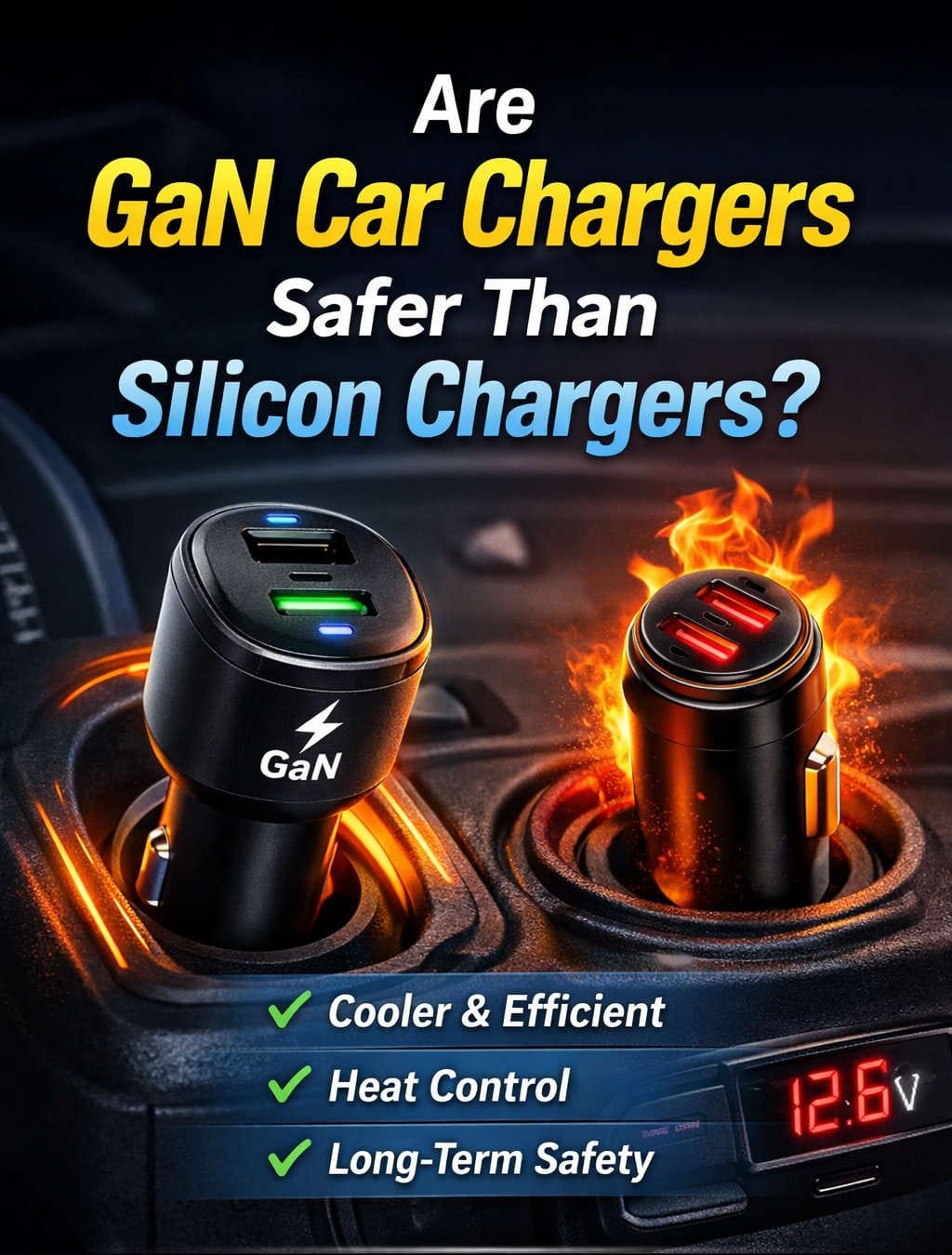
Modern life depends heavily on mobile devices. Smartphones guide our navigation, stream music, handle work emails, and keep us connected on the road. Tablets, laptops, dash cams, and portable hotspots are also commonly powered inside vehicles. As a result, car chargers are no longer simple accessories—they are essential tools that operate for hours at a time in a challenging environment.
With the rise of fast charging, higher wattage outputs, and multiple-device charging, safety has become a major concern. Not all chargers are built the same, and the internal technology plays a critical role in how safely power is delivered. Two technologies dominate today’s market: traditional silicon-based chargers and newer GaN (Gallium Nitride) chargers.
Many drivers now ask an important question: are GaN car chargers safer than silicon chargers, or is this just marketing hype? To answer that honestly, we need to look deeper than advertising claims and understand how each technology behaves in real-world car charging situations.
What Makes Car Charging Different From Wall Charging
Charging inside a car is fundamentally different from charging at home or in an office. A vehicle’s electrical system is not as stable as a household power outlet. Voltage fluctuates constantly depending on engine load, alternator output, and even weather conditions.
When you start your car, voltage can spike. When the engine idles, voltage may drop. When multiple electronic systems are running—air conditioning, headlights, infotainment, heated seats—the power supply becomes even more dynamic.
A safe car charger must be able to:
- Handle sudden voltage changes
- Regulate power accurately
- Prevent overheating in confined spaces
- Protect both the device and the vehicle’s electrical system
This is where the internal charging technology becomes extremely important.
The Role of Semiconductors in Charger Safety
Every charger relies on semiconductor materials to control electricity. These materials act like intelligent gates, allowing power to flow in controlled amounts. The quality, efficiency, and behavior of these semiconductors determine how much heat is generated, how stable the output is, and how safely the charger operates over time.
Silicon: The Traditional Standard
Silicon has been the foundation of electronics for decades. It is reliable, well-understood, and relatively inexpensive. Most older car chargers use silicon-based transistors and components to manage power conversion.
Silicon works well, but it has limitations:
- It struggles with high-frequency switching
- It generates more heat when handling higher power
- It requires larger components to manage that heat
- Efficiency drops as power demand increases
These limitations do not automatically make silicon chargers unsafe, but they do increase the risk factors when chargers are pushed harder, such as during fast charging or multi-device use.
GaN: The Modern Alternative
Gallium Nitride is a newer semiconductor material that has rapidly transformed power electronics. GaN can handle higher voltages and switch electricity much faster than silicon. This allows chargers to be smaller, more efficient, and cooler.
GaN chargers offer several inherent advantages:
- Lower electrical resistance
- Faster switching speeds
- Higher power density
- Reduced heat generation
- Smaller internal components
These characteristics directly influence safety, especially in demanding environments like car interiors.
Heat: The Biggest Safety Factor in Any Charger
If there is one element that determines charger safety more than any other, it is heat. Excess heat is responsible for most charger failures, including melted components, degraded insulation, short circuits, and in rare cases, fires.
Car interiors can already reach high temperatures, especially in summer. When a charger adds its own heat on top of that, the risk multiplies.
How Silicon Chargers Handle Heat
Silicon chargers naturally generate more heat because silicon transistors lose more energy during power conversion. To compensate, manufacturers use:
- Larger heat sinks
- Thicker circuit boards
- More spacing between components
Even with these measures, prolonged high-power charging can cause silicon chargers to become very warm. Over time, repeated heating and cooling cycles weaken internal solder joints and degrade components.
How GaN Chargers Handle Heat
GaN chargers are far more efficient, which means less energy is wasted as heat. Because GaN switches power faster and with lower losses, the charger remains cooler even at higher wattages.
This cooler operation provides several safety benefits:
- Reduced risk of overheating
- Less thermal stress on components
- Longer lifespan
- More stable performance during long charging sessions
In a car, where airflow is limited and ambient temperatures fluctuate, this difference matters significantly.
Size, Design, and Internal Layout Matter More Than You Think
At first glance, smaller chargers may seem less safe. However, with GaN technology, smaller size often means better engineering rather than compromised safety.
Silicon Charger Design Constraints
Silicon chargers require more physical space to manage heat and electrical resistance. This leads to:
- Bulkier housings
- Crowded internal layouts
- Greater reliance on passive cooling
If design quality is poor, these larger components can actually increase failure points, especially when exposed to vibration and heat inside a moving vehicle.
GaN Charger Design Advantages
GaN allows engineers to design chargers with:
- Cleaner internal layouts
- Shorter electrical paths
- Fewer bulky heat-management components
- Better airflow within compact housings
This often results in chargers that are not only smaller but also more structurally sound and electrically stable.
Power Regulation and Voltage Stability
Safety is not just about heat—it is also about delivering the right amount of power consistently. Poor voltage regulation can damage device batteries, reduce charging efficiency, and create electrical stress.
Silicon Chargers Under Load
Silicon chargers perform adequately at lower wattages, but as demand increases:
- Voltage regulation becomes less precise
- Efficiency drops
- Heat increases
- Output stability can fluctuate
These effects are especially noticeable when charging modern smartphones, tablets, or laptops that demand fast, high-wattage charging.
GaN Chargers Under Load
GaN chargers excel under high power demands. Their fast-switching ability allows for:
- Precise voltage control
- Stable current delivery
- Better response to sudden power changes
- Safer fast-charging performance
In a car environment with fluctuating voltage, this stability significantly improves overall safety.
Fast Charging: Convenience vs Risk
Fast charging is one of the main reasons people upgrade their car chargers. However, higher power always increases safety risks if not managed properly.
Risks of Poorly Designed Fast Chargers
Unsafe fast charging can lead to:
- Excessive heat buildup
- Battery stress
- Reduced battery lifespan
- Electrical instability
This risk is not exclusive to silicon or GaN—it depends heavily on design quality. However, GaN technology makes it easier to implement fast charging safely.
Why GaN Is Better Suited for Fast Charging
GaN chargers handle fast charging more safely because they:
- Maintain efficiency at higher wattages
- Stay cooler during extended use
- Support modern charging protocols more effectively
- Reduce internal electrical stress
This makes GaN particularly suitable for charging power-hungry devices like tablets and laptops in a car.
Long-Term Safety and Durability
Safety is not just about day-one performance. A charger that degrades over time becomes increasingly risky.
Silicon Charger Aging
Repeated heat cycles cause silicon chargers to:
- Develop micro-cracks in solder joints
- Lose insulation effectiveness
- Experience component drift
- Become less reliable
As chargers age, the risk of internal shorts or unstable output increases.
GaN Charger Longevity
Because GaN chargers run cooler, they experience:
- Less thermal fatigue
- Slower material degradation
- More consistent long-term performance
This makes GaN chargers safer over months and years of regular use.
The Importance of Built-In Safety Protections
Regardless of technology, a safe car charger must include multiple protection systems.
Key protections include:
- Over-voltage protection
- Over-current protection
- Over-temperature protection
- Short-circuit protection
- Intelligent power negotiation
GaN chargers are often paired with advanced safety controllers because they are designed for modern fast-charging standards. However, high-quality silicon chargers can also include these protections if properly engineered.
Why Cheap Chargers Are Always Risky
One of the biggest dangers in car charging comes from ultra-cheap, unbranded chargers. These often:
- Lack proper safety certifications
- Use low-quality components
- Skip essential protection circuits
- Overheat easily
Whether silicon or GaN, poorly made chargers are unsafe. GaN technology does not magically fix bad engineering.
Choosing a Safe Car Charger: A Practical Guide
To ensure safety, focus on the following factors rather than technology alone:
- Choose reputable brands with proven quality control
- Look for clearly stated safety certifications
- Ensure compatibility with your device’s charging standards
- Avoid chargers that get excessively hot during use
- Prefer chargers designed for continuous high-power operation
- Read long-term user reviews, not just initial impressions
If choosing between two equally well-built chargers, GaN usually offers a safer and more future-proof option.
Are Silicon Car Chargers Still Safe to Use?
Yes, silicon car chargers are not inherently dangerous. Many high-quality silicon chargers operate safely at moderate power levels. If you:
- Charge one device at a time
- Use lower wattage
- Avoid fast charging
A well-designed silicon charger can serve you safely.
However, as device power demands increase, the margin for error becomes smaller. This is where GaN chargers clearly stand out.
Real-World Driving Scenarios and Safety
In daily commuting, short charging sessions place minimal stress on both charger types. On long drives, road trips, or ride-sharing scenarios where devices charge continuously for hours, GaN chargers provide a noticeable safety advantage due to their cooler operation and stability.
In extreme weather conditions—hot summers or cold winters—GaN chargers also handle thermal stress better, reducing the risk of performance degradation.
The Final Verdict: Are GaN Car Chargers Safer?
When all factors are considered—heat management, efficiency, voltage stability, durability, and long-term reliability—the answer becomes clear.
GaN car chargers are generally safer than silicon chargers, especially for fast charging and high-power use.
This does not mean silicon chargers are unsafe, but GaN technology offers:
- Lower operating temperatures
- Better performance under stress
- Longer lifespan
- Improved safety margins in demanding environments
For modern drivers who rely heavily on in-car charging, GaN chargers represent a smarter and safer evolution of charging technology.
Closing Thoughts
Car chargers may seem like small accessories, but they play a critical role in powering the devices we depend on every day. Safety should never be an afterthought—especially in a vehicle where heat, vibration, and electrical fluctuations are constant.
GaN technology is not just a trend; it is a meaningful improvement in how power is delivered safely and efficiently. If you value device protection, long-term reliability, and peace of mind while charging on the road, investing in a well-built GaN car charger is a wise decision.
Discover more from Auto Volt Tech
Subscribe to get the latest posts sent to your email.
 Auto Volt Tech