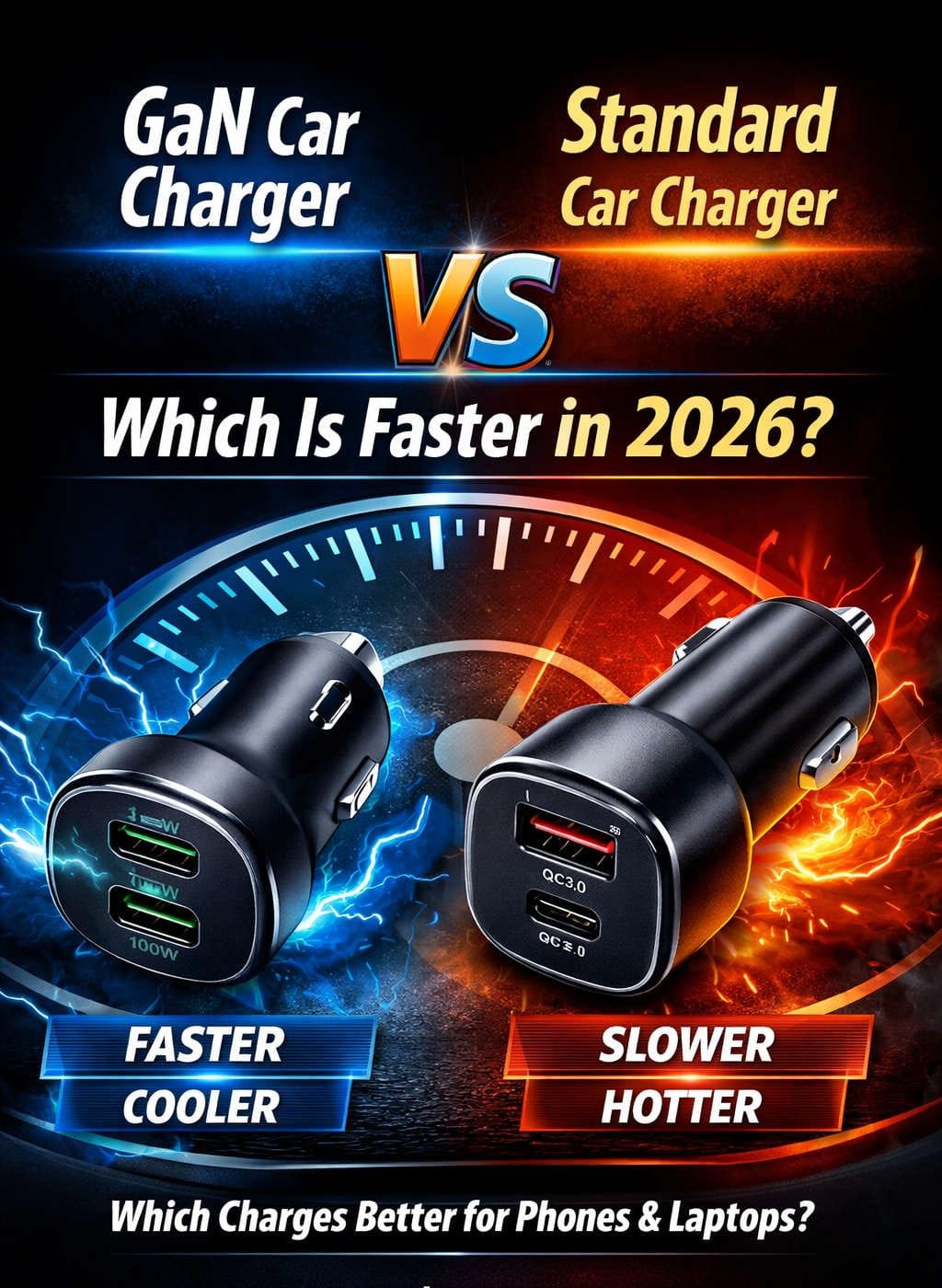
Car charging technology has quietly become one of the most important accessories in modern vehicles. In 2026, cars are no longer just a means of transportation; they are mobile offices, entertainment hubs, and navigation centers. Smartphones, tablets, laptops, handheld gaming devices, dash cameras, and other electronics now depend heavily on reliable in-car power. As device power demands increase, drivers are asking a simple but critical question: Is a GaN car charger faster than a standard car charger?
The answer is not just about speed in isolation. Charging performance in real-world driving conditions depends on efficiency, heat management, protocol compatibility, sustained power delivery, and the ability to handle multiple devices at once. This article explores all of these factors in depth, providing a clear, up-to-date comparison between GaN (Gallium Nitride) car chargers and traditional silicon-based car chargers as they exist in 2026.
Rather than focusing on marketing claims, this guide explains how both technologies actually behave in cars, what users experience day to day, and which option delivers faster and more reliable charging for modern devices.
Understanding the Two Charger Technologies
To understand why GaN chargers are often faster, it is important to first understand how each charger type works at a fundamental level.
How Standard Car Chargers Work
Standard car chargers rely on silicon semiconductors, a technology that has powered consumer electronics for decades. These chargers convert the vehicle’s 12-volt DC power into lower voltages suitable for USB-A or USB-C outputs. Silicon-based components are well understood, relatively inexpensive, and easy to manufacture at scale.
For basic charging needs, such as powering older phones or small accessories, silicon chargers perform adequately. However, as charging standards evolved and power requirements increased, silicon began to show limitations. Higher wattage output creates more heat, which forces designers to use larger components and conservative power limits to prevent overheating. This is why many traditional car chargers struggle to deliver their maximum advertised power for extended periods, especially inside warm vehicles.
What Makes GaN Different
GaN, or Gallium Nitride, is a newer semiconductor material that behaves very differently from silicon. It allows electricity to flow more efficiently at higher voltages and frequencies, which significantly reduces energy loss during power conversion. In practical terms, GaN components can handle more power while generating less heat.
This efficiency advantage allows GaN car chargers to be smaller, lighter, and more powerful at the same time. Instead of wasting energy as heat, more of the vehicle’s power is delivered directly to the device being charged. In the confined and often hot environment of a car, this difference becomes especially important.
What “Faster Charging” Really Means in a Car
Charging speed is often misunderstood. Many users assume that a charger is fast simply because it has a high wattage number printed on the packaging. In reality, charging speed in a car depends on several interacting factors.
First, the charger must support the fast-charging protocol used by the device. Modern phones and laptops negotiate power dynamically using standards such as USB Power Delivery and Programmable Power Supply. Second, the charger must be able to sustain high output without overheating. Third, the vehicle’s electrical system and ambient temperature play a role.
A charger that briefly reaches high wattage but quickly throttles due to heat will feel slower than one that maintains stable output over time. This is where the difference between GaN and standard chargers becomes very noticeable.
Charging Speed Comparison in Real-World Use
In controlled environments, both GaN and standard chargers may appear similar. In real cars, under real driving conditions, performance begins to separate.
Peak Power vs Sustained Power
Standard silicon chargers often advertise high wattage numbers, but many cannot maintain those levels continuously. When charging a modern smartphone, this may not be obvious at first, since phones draw peak power only briefly. However, with larger devices like tablets or laptops, the charger must deliver high wattage for much longer periods.
GaN chargers excel in sustained delivery. Because they generate less internal heat, they can maintain near-maximum output for extended sessions. This means a laptop charging on a GaN car charger will typically reach higher charge levels faster during a commute compared to a standard charger that gradually reduces output to protect itself.
Phone Charging Performance
For modern smartphones released in the mid-2020s, GaN chargers consistently deliver faster real-world results. This is not because the phones charge beyond their designed limits, but because GaN chargers support advanced power negotiation more efficiently. They respond faster to voltage and current adjustments and are less likely to drop power during heat buildup.
Standard chargers can still fast-charge phones, but users may notice slower speeds during long navigation sessions or when charging while running multiple apps, especially in summer conditions.
Laptop and Tablet Charging
Laptops highlight the performance gap more clearly than phones. Many laptops require between 60 and 100 watts to charge effectively. Standard chargers often struggle at these levels in cars, especially when also powering another device.
GaN car chargers handle this scenario far better. A single GaN charger can power a laptop and a phone simultaneously without dramatic drops in performance. This makes GaN the clear winner for professionals who work from their vehicles or rely on laptops during travel.
Heat Management and Its Impact on Speed
Heat is the silent enemy of charging speed. Inside a parked or moving car, temperatures can rise quickly, and chargers have very little airflow to help dissipate heat.
Why Heat Slows Charging
When a charger overheats, its internal protection systems reduce output to prevent damage. This throttling may not be visible to the user, but it directly slows charging speed. Over time, repeated exposure to high heat can also degrade components, reducing performance permanently.
GaN’s Advantage in Thermal Efficiency
GaN chargers produce less heat at the same power level, which gives them a significant advantage in vehicles. Even when charging at high wattage, GaN units stay cooler and are less likely to throttle. This allows devices to charge faster and more consistently, particularly during long drives.
Standard chargers tend to run hotter, especially when delivering more than 45 watts. In warm climates or poorly ventilated car interiors, this can lead to noticeable speed reductions.
Efficiency and Power Utilization
Efficiency determines how much of the car’s power actually reaches your device. Even small efficiency differences matter when charging at high wattages.
GaN chargers convert power more efficiently, meaning less energy is wasted. This efficiency advantage translates into faster charging because more power is available to the device instead of being lost as heat. Over a 30- or 60-minute drive, this difference can amount to a significant increase in battery percentage.
Standard chargers, while still functional, are inherently less efficient. As wattage increases, efficiency drops, and heat losses increase. This limits how fast devices can realistically charge in a car environment.
Size, Design, and Practical Usability
Charging speed is not the only factor that matters to drivers. Physical design plays a surprisingly important role in usability.
GaN chargers are typically much smaller than standard chargers with the same power rating. This allows them to fit better in crowded dashboards and center consoles. Smaller size also reduces strain on the vehicle’s power socket, which can improve long-term reliability.
Standard chargers often require bulkier designs to manage heat, which can make them awkward to use in tight spaces. This may not affect speed directly, but it does impact convenience and overall user experience.
Multi-Device Charging Performance
In 2026, it is common to charge more than one device at a time in a car. Phones, tablets, and laptops often share the same charger during family trips or work travel.
GaN chargers handle multi-device charging more intelligently. They dynamically distribute power between ports based on device demand, maintaining optimal speeds for each device. This means a phone will not suddenly slow down just because a laptop is plugged in.
Standard chargers are more limited in this regard. When multiple devices draw power simultaneously, output is often divided unevenly, leading to slower charging across the board. In some cases, one device may stop fast charging entirely.
Compatibility With Modern Charging Standards
Charging speed also depends heavily on protocol support. Modern devices rely on sophisticated communication between the charger and the device to determine safe and optimal power levels.
GaN chargers released in 2026 almost always support the latest USB Power Delivery versions, including advanced features that allow fine-grained control of voltage and current. This ensures devices charge as quickly and safely as possible.
Standard chargers may support basic fast charging but often lack full support for newer features. As devices continue to evolve, this gap becomes more noticeable, making GaN chargers more future-proof.
Long-Term Reliability and Durability
A charger that delivers fast speeds today but degrades quickly is not truly a good investment.
Because GaN chargers operate at lower temperatures, their components experience less stress over time. This often results in longer lifespan and more consistent performance. Many users report that GaN chargers maintain their charging speed even after years of use.
Standard chargers, especially low-cost models, are more prone to heat-related wear. Over time, this can lead to slower charging speeds, unstable connections, or complete failure.
Cost vs Performance in 2026
One of the biggest objections to GaN chargers in the past was price. In 2026, this gap has narrowed significantly.
While GaN chargers are still slightly more expensive on average, the difference is often small compared to the performance benefits. When factoring in faster charging, better multi-device support, and longer lifespan, GaN chargers often offer better overall value.
Standard chargers remain a viable option for light use or tight budgets. However, for users who rely heavily on in-car charging, the performance advantage of GaN is difficult to ignore.
Real-World Use Case Comparisons
For drivers who only need to top up a phone during short commutes, both charger types will work. The difference in speed may be minimal.
For drivers who navigate extensively, stream music, or use their phone as a hotspot, GaN chargers provide more stable and faster charging.
For professionals charging laptops or tablets, GaN chargers are significantly faster and more reliable.
For families charging multiple devices simultaneously, GaN chargers offer smoother performance with fewer slowdowns.
Which Is Faster in 2026: Final Verdict
When all factors are considered, GaN car chargers are clearly faster than standard car chargers in 2026. This speed advantage comes not from unsafe power delivery, but from better efficiency, superior heat management, and advanced protocol support.
Standard chargers are not obsolete, but they are increasingly limited in high-demand scenarios. GaN chargers represent the next stage of in-car charging technology, offering faster, more consistent performance that matches the needs of modern devices.
For anyone who values charging speed, reliability, and future-proof performance, GaN car chargers are the superior choice in 2026.
Discover more from Auto Volt Tech
Subscribe to get the latest posts sent to your email.
 Auto Volt Tech