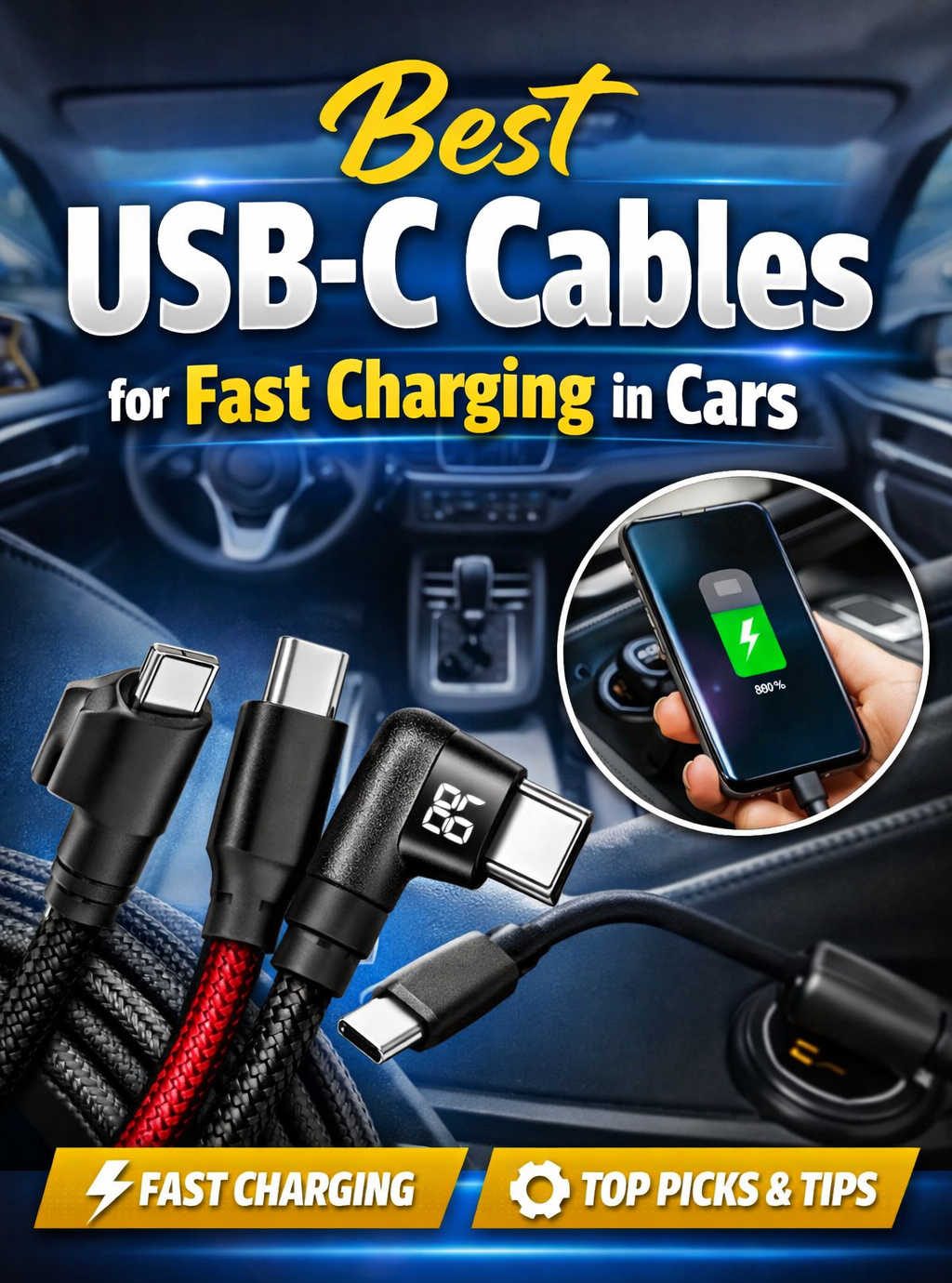
Fast charging in the car has quietly become one of those things people rely on every single day. Whether you’re navigating traffic, streaming music, using Android Auto or Apple CarPlay, or simply keeping your phone alive on a long trip, the humble charging cable plays a bigger role than most drivers realize.
Many people assume charging speed depends only on the charger or the vehicle’s port — but the cable itself is often the bottleneck. The wrong cable can slow charging dramatically, cause connection instability, or wear out within months. The right cable, on the other hand, delivers faster power transfer, improved safety, and long-term reliability even in the harsh conditions inside a vehicle.
This guide walks you through everything you need to know about choosing the best USB-C cables for fast charging in cars. You’ll learn how charging standards work, what specifications actually matter, and which cables stand out for durability, speed, and usability. By the end, you’ll be able to confidently choose a cable that fits your device, your driving habits, and your budget.
Why Your USB-C Cable Matters in a Car Environment
Charging inside a vehicle is fundamentally different from charging at home. The environment is more demanding in several ways:
- Temperature swings from cold mornings to hot interiors
- Constant vibration and movement
- Frequent plugging and unplugging
- Limited space around ports
- Power fluctuations depending on the charger
These factors accelerate wear and stress on cables. A thin or poorly constructed cable might function perfectly on a desk yet fail quickly in a car.
Additionally, modern smartphones and tablets consume significantly more power than devices from a few years ago. Fast-charging protocols allow devices to draw higher currents safely, but only if the cable supports it. If it doesn’t, the system falls back to slower speeds.
That’s why cable selection directly affects:
- Charging speed
- Device safety
- Reliability of infotainment connections
- Long-term cost efficiency
Choosing well once is often cheaper than replacing weak cables repeatedly.
Understanding USB-C Fast Charging Basics
To make an informed purchase, it helps to understand what’s happening behind the scenes when you connect your device.
Power Delivery Explained
USB-C introduced the ability to negotiate power levels dynamically between charger and device. Instead of sending fixed current, both sides communicate and settle on the optimal voltage and amperage.
Modern cables may support:
- Standard charging for smaller devices
- Mid-range fast charging for phones
- High-wattage delivery capable of powering laptops
Cables rated for higher wattage include internal components that signal their capacity. This ensures safety while enabling faster charging when compatible hardware is present.
Charging Is Only as Fast as the Weakest Link
Fast charging requires alignment between:
- The car charger or vehicle port
- The cable rating
- The device capability
If any component is limited, overall performance drops accordingly. Even the most powerful car charger cannot compensate for a low-capacity cable.
Data Transfer Considerations
Many drivers rely on USB connections for infotainment features. Not every charging cable handles data reliably. Some prioritize power delivery and provide only basic transfer capability.
If you use navigation mirroring or media sync, choosing a cable with stable data performance is essential.
Key Features to Look For in a Car Charging Cable
When evaluating USB-C cables, focus on characteristics that impact real-world performance.
Power Rating
A cable’s wattage rating indicates how much power it can safely deliver.
For everyday flexibility:
- Aim for at least 60W capability
- Choose 100W if you want maximum compatibility
Higher ratings allow charging across multiple device categories, from phones to laptops.
Construction Quality
Durability matters more in cars than almost anywhere else. Look for:
- Braided nylon exteriors
- Reinforced strain relief at connectors
- Metal or alloy connector housings
These reduce fraying, internal breakage, and connector damage.
Internal Safety Components
Higher-quality cables include intelligent electronics that regulate current and protect devices. This reduces overheating risk and helps maintain stable charging speeds.
Cable Length
Length affects both convenience and organization.
Short cables:
- Reduce clutter
- Improve stability
- Work well for driver-side ports
Longer cables:
- Serve rear passengers
- Allow flexible routing
- Improve accessibility
Choose based on your seating layout and usage.
Connector Orientation
Right-angle connectors can be extremely practical in vehicles, minimizing cable strain and keeping wires out of the way.
Top USB-C Cable Recommendations for Fast Charging in Cars
Below are well-regarded options known for performance, reliability, and availability. Each offers distinct advantages depending on user needs.
UGREEN USB-C to USB-C 100W Cable
This cable is widely appreciated for balancing durability and performance. Its braided exterior protects against wear, while metal connectors add structural strength.
Key highlights include:
- High power support suitable for phones and laptops
- Reinforced design for frequent use
- Stable data transfer capability
- Solid compatibility with fast-charging protocols
This option works particularly well for users who want one cable for multiple device types.
Best suited for:
Drivers seeking dependable all-around performance.
Baseus Silky Series USB-A to Type-C Cable
Unlike rigid braided models, this cable uses a flexible silicone exterior that resists tangling and remains easy to handle in confined spaces.
Its design emphasizes:
- Smooth texture and flexibility
- Reinforced connector structure
- Strong charging performance
- Everyday usability
This softness can be surprisingly helpful when cables must bend around console edges.
Best suited for:
Drivers prioritizing comfort and flexibility.
Baseus Display 2 Fast Charging Cable
This cable stands out visually and functionally thanks to an integrated power display that shows charging information in real time.
Features include:
- Visible wattage monitoring
- Durable braided construction
- Intelligent power regulation
- High charging capability
Seeing actual charging output can help identify issues with chargers or ports quickly.
Best suited for:
Tech enthusiasts who like performance feedback.
Porodo Braided USB-C Cable
Designed with durability in mind, this cable emphasizes resilience under repeated bending and stress.
Notable traits include:
- Heavy-duty braided structure
- Aluminum connector housing
- Reliable fast charging
- Stable connectivity
This makes it appealing for heavy daily usage or professional driving.
Best suited for:
Users prioritizing rugged longevity.
Baseus Cafule USB-C Cable
This model focuses on strength and compatibility across charging scenarios.
Core advantages:
- Alloy connector materials
- Strong charging support
- Multi-device compatibility
- Included cable management strap
It balances durability and organization.
Best suited for:
Drivers wanting a long-lasting structured cable.
Choosing the Right Cable for Your Driving Habits
Your ideal cable depends heavily on how you use your vehicle.
Daily Commuting
Short, durable cables minimize clutter and provide consistent reliability.
Ride-Sharing or Taxi Driving
Longer or extra-rugged cables accommodate frequent passenger use.
Road Trips
High-power cables capable of charging tablets or laptops add versatility.
Infotainment Integration
Stable data performance becomes as important as charging capability.
Cable Care and Longevity Tips
Even high-quality cables benefit from mindful handling.
- Avoid sharp bends near connectors
- Remove cables by gripping the plug
- Keep ports clean
- Store loosely when not in use
Small habits extend lifespan significantly.
Safety Considerations When Buying
Low-cost cables sometimes exaggerate capabilities or skip protective components. Risks include:
- Slower charging than expected
- Overheating
- Inconsistent connections
- Potential device stress
Investing in reputable brands generally reduces these risks and ensures consistent performance.
Emerging Trends in Automotive Charging
Charging technology continues to evolve alongside consumer electronics.
Expect to see:
- Higher wattage standards
- Smarter cable electronics
- Integrated monitoring displays
- Retractable automotive cable systems
- Multi-function cables combining power and video
Staying aware of these trends helps future-proof purchases.
Practical Buying Checklist
Before purchasing, confirm:
- Power rating meets your needs
- Build materials support durability
- Length suits vehicle layout
- Data capability matches usage
- Brand reliability inspires confidence
Checking these five factors prevents most disappointments.
Final Thoughts
A USB-C cable might seem like a minor accessory, yet it plays a major role in modern driving convenience. As smartphones and mobile workflows become increasingly central to navigation, communication, and entertainment, dependable charging matters more than ever.
Selecting the right cable improves:
- Charging speed
- Device safety
- Connection stability
- Overall driving experience
The recommended cables in this guide offer strong options across different priorities, whether flexibility, ruggedness, monitoring capability, or balanced performance.
Ultimately, the best USB-C cable for fast charging in cars is one that matches your specific usage patterns and device ecosystem. Taking a little time to choose wisely ensures smoother daily routines and fewer frustrations on the road.
Discover more from Auto Volt Tech
Subscribe to get the latest posts sent to your email.
 Auto Volt Tech